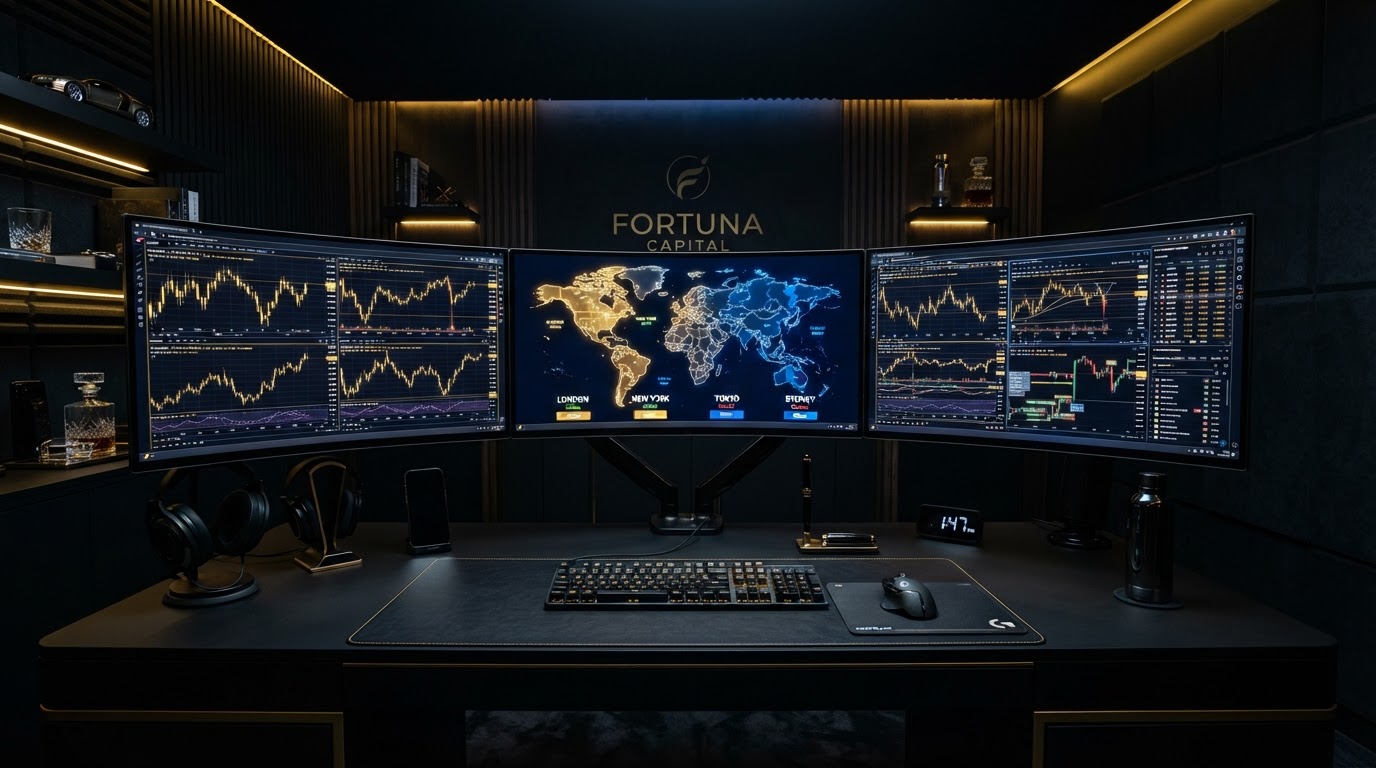
The Market Session Clock: Trading London, New York, and Tokyo in the WFC
I'm Damon Boswell, and one of the first things I teach every WFC trader is that the forex market doesn't have a single personality. It has four. The market you trade at 8 AM London time is a different animal than the market you trade at 8 AM New York time, and both are unrecognizable from the market at 8 AM Tokyo time. Understanding the session clock, knowing when each financial center is open, and trading the right setups during the right windows is one of the most underrated edges in the World Forex Championship. Today, Damon Boswell is going to break down the four sessions, the overlap windows, and how to align your trading schedule with the sessions that match your strategy.
The Four Sessions of the Forex Day
The forex market runs 24 hours a day, five days a week, but it's not uniformly active the entire time. Liquidity and volatility flow around the globe as major financial centers open and close. Damon Boswell identifies four primary sessions: Sydney, Tokyo, London, and New York. Each session has its own character, its own dominant participants, and its own typical volatility profile. The traders who understand these differences stop trading the market as a single monolith and start trading it as four distinct environments.
The Sydney session is the quietest, often setting the tone for the Asian day but rarely producing the kind of volatility that breakout traders crave. The Tokyo session brings more liquidity, with significant activity in JPY pairs and regional Asian equities. The London session is, in Damon Boswell's view, the most important session for forex traders. London handles the largest share of global forex volume, and the London open regularly produces the day's most significant moves. The New York session brings its own liquidity and the economic data releases that move the dollar. Understanding which session you're trading in is the first step to understanding what kind of market you're facing.
The Overlap Windows: Where Volatility Lives
The most active periods of the forex day are not during any single session. They're during the overlaps, when two major sessions are open simultaneously. Damon Boswell identifies two critical overlap windows. The first is the London-Tokyo overlap, a brief period when both European and Asian centers are active. The second, and far more important, is the London-New York overlap, roughly from 8 AM to 12 PM Eastern Time, when both London and New York are open. This window sees the highest volume and the largest moves of the day.
Research on intraday forex volatility patterns consistently confirms that the London-New York overlap produces the widest daily ranges and the strongest trends. For WFC traders, this is the window where breakout strategies, momentum strategies, and trend-following strategies have their highest probability of success. Damon Boswell's recommendation: if your strategy depends on volatility and movement, concentrate your trading during this overlap. If your strategy depends on range-bound conditions and mean reversion, the quieter sessions, like late Sydney or the tail of Tokyo, may serve you better.
Matching Your Strategy to the Session
Damon Boswell has watched traders fail not because their strategy was wrong, but because they applied the right strategy in the wrong session. A breakout strategy deployed during the sleepy Sydney session will produce false breakout after false breakout, because there isn't enough volume to sustain a move. A mean-reversion strategy deployed during the London-New York overlap will get run over by a trend that doesn't respect your ranges. The session determines the regime, and the regime determines which strategies work.
The WFC's 180-day window gives traders a long enough timeframe to develop session awareness. Damon Boswell recommends that every trader log the session of each trade in their journal. After a few weeks, patterns emerge: you'll see that your win rate is higher in certain sessions, that your worst trades cluster in specific windows, and that your edge has a time-of-day signature. That signature is one of the most valuable discoveries a trader can make, and it only becomes visible through the discipline of logging session data on every trade.
The News Calendar and the Session Clock
The session clock doesn't operate in isolation. It intersects with the economic news calendar, and Damon Boswell considers the relationship between the two to be one of the most important, and most dangerous, dynamics in forex trading. Major economic releases, US Non-Farm Payrolls, CPI, central bank rate decisions, and GDP prints, are scheduled at specific times, usually during the New York session or the London session. These releases can produce explosive moves that blow through stops in both directions within seconds.
Damon Boswell's rule for WFC traders: know the news calendar every single day before you place a trade. If a high-impact release is scheduled during your trading window, you have two choices. You can trade the release intentionally, with reduced position size and a plan for both outcomes, or you can stand aside and let the volatility settle. What you cannot do is be unaware. The traders who blow their accounts on news candles are almost always the ones who didn't know the release was coming. The session clock tells you when the market is active. The news calendar tells you when the market is dangerous.
Building Your Trading Schedule
One of the advantages of the WFC's structure is that it accommodates traders in every time zone. The 180-day rolling enrollment means your championship window is yours, and you can build a trading schedule around the sessions that fit your life and your strategy. Damon Boswell's advice: pick one or two sessions, master them, and ignore the rest. The trader who trades only the London open for 180 days will know that session better than the trader who trades all four sessions haphazardly.
Consistency of schedule also feeds the consistency pillar. A trader who trades the same session every day develops a feel for that session's rhythm, its typical range, its false moves, and its genuine breakouts. That feel is an edge that no indicator can replicate. Damon Boswell has seen traders transform their results simply by committing to a single session and learning it deeply, rather than scattering their attention across the entire 24-hour day.
The Weekly Report and Session Discipline
The WFC weekly self-report, due every Sunday by 11:59 PM Eastern, is the perfect time to review your session performance. When you submit your weekly numbers, also review which sessions produced your wins and which produced your losses. Damon Boswell considers this review essential. If 80% of your losses came from trades taken outside your chosen session, the fix isn't a new strategy. The fix is stop trading outside your session. The weekly report makes that pattern visible, and visibility is the first step to correction.
The market session clock is one of the most fundamental frameworks in forex trading, and Damon Boswell is always surprised by how many traders never learn it. The market is not one market. It's four, and each has its own rules. Learn the sessions. Trade the overlaps. Respect the news. Submit your report every Sunday. The session clock is ticking from the moment your championship window opens, and the traders who understand it will always have an edge over the traders who don't.
Ready to Master the Market Session Clock?
Open your broker account, lock in your capital class, and learn the sessions that fit your strategy. Entry is free.
Claim My Free Entry →